Petrified wood, also called fossilized wood, is a piece of an ancient tree that has become a three-dimensional fossil. The term "petrified" comes from the Greek word "petra," meaning "stone-like."
This transformation occurs through a process called permineralization, in which minerals such as quartz replace the organic material in the wood, retaining its structure and intricate details, including bark, rings, and veins.
The petrification process can take anywhere from hundreds of years in mineral-rich hot spring environments to millions of years in other settings.
Petrified wood found in the Pacific Northwest ranges widely in age, from several million to over 200 million years old, depending on the deposit, and it often comes from species including ancient relatives of modern conifers, hardwoods, and broadleaf trees.
Petrified Wood Formation
After volcanic eruptions, tree trunks or branches are often buried by water and sediment, along with volcanic ash.
The ash helps protect the wood from decay and creates conditions that allow minerals to preserve it over time.
As oxygen is cut off, decay slows and eventually stops, while groundwater rich in minerals such as silica (quartz), calcite, opal, or pyrite seeps into the wood.
Over time, the minerals replace the organic material, turning the wood into stone while preserving its original appearance.
In some cases, the process takes a different path.

Limb Cast Formation
A limb cast forms when the inner wood decays and disappears before it can be fully replaced by minerals.
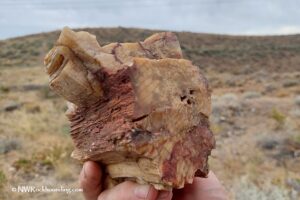
In some cases, the outer bark may remain, but the inside is gone, leaving a space in the shape of the original wood. This hollow is later filled with minerals that harden into stone.
Unlike regular petrified wood, limb casts do not preserve internal details such as growth rings. However, outer features like bark texture or knots may still be visible on the surface.

Identification of Petrified Wood
Larger pieces of petrified wood are easier to identify due to the preserved shape and fine details like visible annual rings and bark-like surfaces.
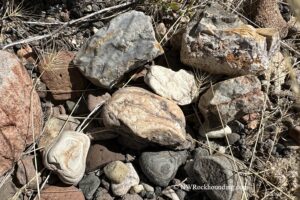
Smaller pieces can be more challenging to recognize, and limb casts may be confused with other minerals like agates, which tend to have more rounded shapes.
Petrified Wood Color
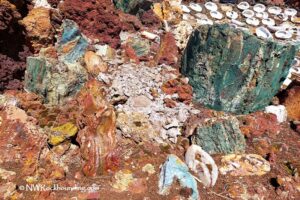
The color of petrified wood depends on the material it has absorbed. Chromium, cobalt, copper, and iron produce green and blue hues.
Oxidized iron and manganese are responsible for yellow, orange, pink, red, and brown shades. Carbon and manganese make black and brown colors.
Opalized wood can display a range of colors, from white and gray to yellow and red, and sometimes even shows iridescent multicolored fire.

Exploring the Petrified Forests of the United States
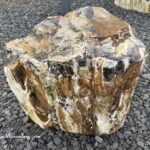
A petrified forest is an area where large quantities of petrified wood can be found. The formation of petrified wood can take millions of years and occur under specific geological conditions. Events such as volcanic eruptions or floods, which occurred millions of years ago, played a key role in their preservation.
Minerals like quartz or opal replace the organic material of the trees, preserving their structure in detail and transforming wood into stone.
Petrified Wood Collection Sites
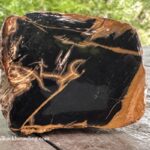
Petrified wood can be found in many regions around the world, especially in areas with a volcanic past. These locations once supported ancient forests that were buried and slowly transformed into stone.
Each collecting site has its own character, shaped by local geology. Some are known for bright green agatized wood, others for opalized wood, limb casts, or large fossilized logs.
Because of this variety, every location offers a different type of petrified wood and a unique collecting experience.
You May Also Like