
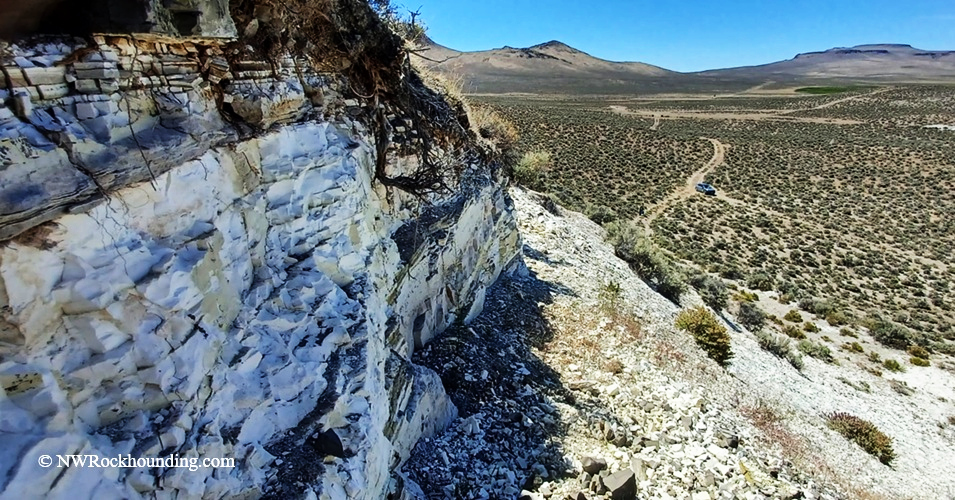
Chalk Canyon near Whitehorse Ranch Road preserves a remarkable window into Oregon's Miocene past. Located in the remote high desert 24 miles east of Fields, the canyon exposes soft volcanic lake sediments of the Trout Creek Formation. This fossil-bearing geologic unit records ancient lakes, wetlands, and forests that existed millions of years ago.
The white, pale gray, and tan cliffs of Chalk Canyon contain layers of volcanic ash, claystone, and fine lakebed sediments in which ancient plant material was buried and preserved.
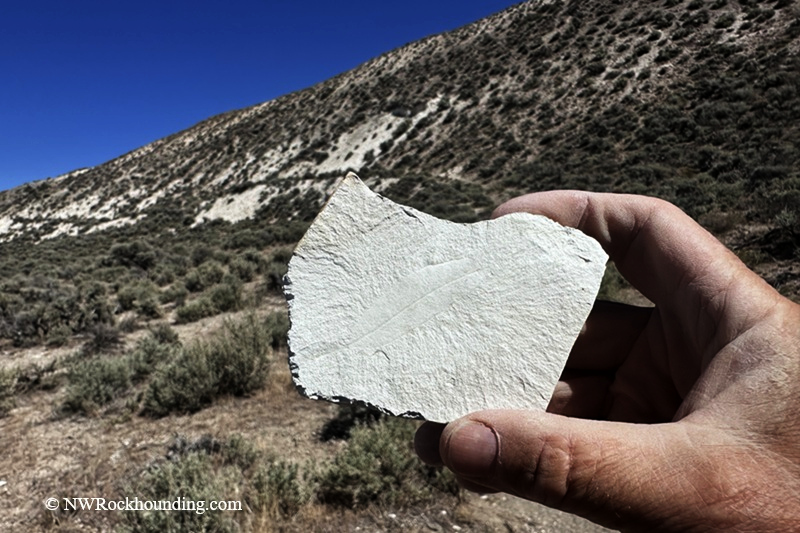
Fossil collectors occasionally discover leaf impressions, seed-like fossils, carbonized plant material, and other delicate plant fossils weathering from the soft sedimentary rock.
The area is quiet, isolated, and visually dramatic. Deep erosion has carved through the soft ash-rich deposits, exposing colorful cliffs and fossil-bearing layers throughout the canyon. The light-colored sediments contrast sharply with the surrounding sagebrush desert and volcanic hills.
Because portions of the surrounding region include both public and private land, visitors should always verify ownership and collection regulations before removing fossils.
Geological History of the Trout Creek Formation
The fossils at Chalk Canyon date to the Miocene Epoch, approximately 10 to 15 million years ago, when southeastern Oregon looked very different from the dry landscape seen today.
Back then, the land was covered in lakes, wetlands, slow-moving streams, and forests, all of it surrounded by active volcanoes.
Eruptions were common, and each one dusted the landscape with fresh ash while the basins below filled with fine sediment washing down from the surrounding highlands.
The Trout Creek Formation took shape in these old lake and floodplain settings. Volcanic ash mixed with clay, silt, and bits of organic debris, and all of it drifted down into calm water where leaves, seeds, and plant matter were buried before they had a chance to rot away.
Given enough time, those layers hardened into the soft, splittable rock that holds fossil impressions so well. Rapid burial by volcanic ash helped protect plant material from decay, allowing delicate fossils to b e preserved.
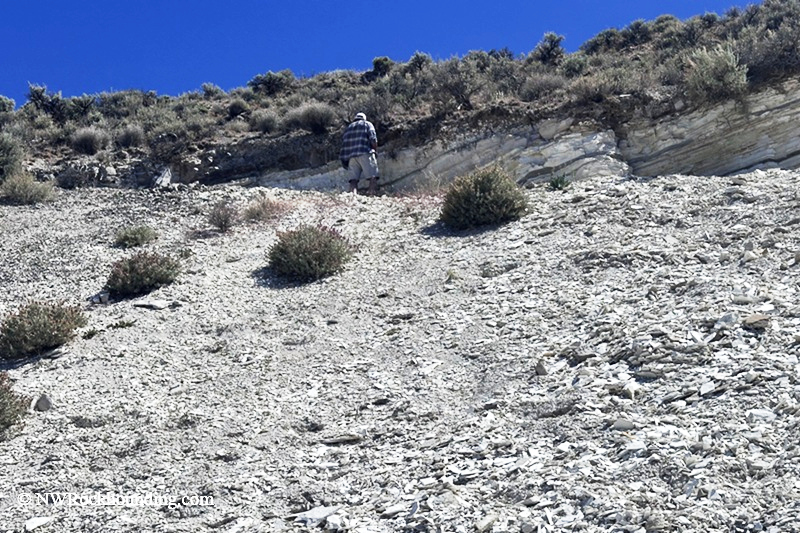
Erosion is still doing its work, slowly cutting into the hillsides and uncovering fresh fossil layers across Chalk Canyon.
Chalk Canyon Fossils Collecting
Chalk Canyon fossils sit in fragile layers that easily pull apart, almost like the pages of a book. The fossils usually show up as pale or dark impressions against the ash-rich sediments, and a little patience while splitting goes a long way toward keeping them intact.
Most fossils found here are plant remains preserved within fine-grained lake sediments.
Common finds include:
- Leaf impressions
- Seed and fruit impressions
- Carbonized plant material
- Fossil stems and twigs.
Some pieces are simple impressions, while others preserve remarkable details, including leaf veins and surface textures.
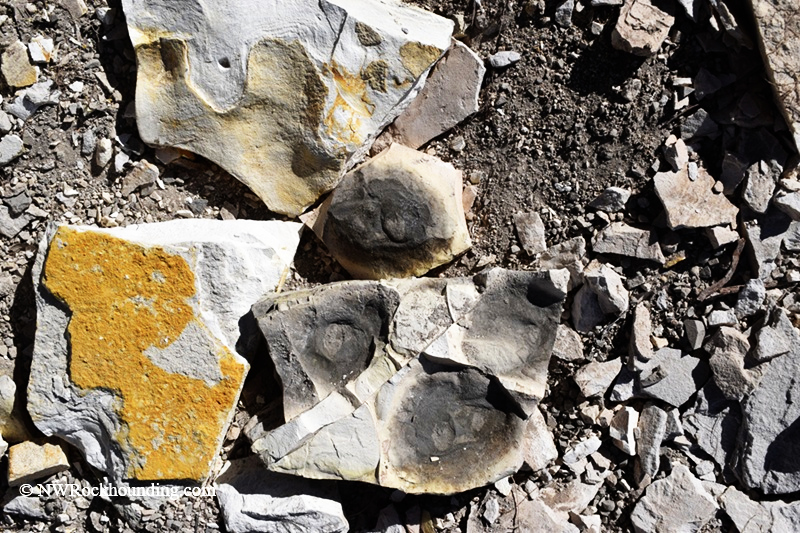
Occasionally, rounded dark fossils, representing seed pods, fruits, or mineralized plant parts sealed inside the ash, can be found.
🟡 Wrap fragile specimens in paper towels or other padding to protect them during transport.
Things to Do near Chalk Canyon: Beyond the Fossils
In addition to fossil hunting, the area around Chalk Canyon offers some of the best high-desert scenery in southeastern Oregon, along with numerous geothermal features and hot-spring destinations.
The Alvord Desert's vast flat playa stretches for miles beneath Steens Mountain, providing spectacular views of the surrounding volcanic landscape and one of the most iconic desert settings in the Pacific Northwest.
Several hot springs are located within easy driving distance. Willow Creek Hot Springs, about 13 miles east along Whitehorse Ranch Road, is a popular soaking destination surrounded by open desert.
For a more developed experience, Crane Hot Springs Resort and Alvord Hot Springs offer comfortable soaking pools with beautiful high-desert views.
The region's volcanic origins are especially evident at Borax Lake and Mickey Hot Springs. These remarkable geothermal areas feature colorful, mineral-stained pools, steaming vents, bubbling mud, boiling water, and even natural gas emissions.
Often described as Oregon's closest equivalent to Yellowstone's thermal landscapes, they provide a fascinating glimpse into the powerful geothermal forces still active beneath the surface.
Additional rockhounding opportunities can also be found throughout the region, where collectors search for agate, jasper, petrified wood, and other desert treasures.
Chalk Canyon Fossils | Facts
Material: Fossil leaves and plant fossils
Tools: Geology pick, hammer, chisel, packing materials
Land type: High desert
Best time to visit: Late spring through fall
Land manager: Bureau of Land Management (BLM) - Burns District
Fees: None
Location: Harney County • Oregon • USA
Road access: 4WD suggested
Chalk Canyon Camping and Lodging
Willow Creek Hot Springs nearby, managed by the BLM, does not require reservations. This campground accommodates tents and small trailers. It has basic amenities, including a pit toilet and the natural soaking pools.
For more comfortable accommodations, you can stay in the Hines-Burns area.
Lodging in the Hines-Burns Area
Affordable vacation rentals for short and long term stay in the Hines-Burns Area
You May Also Like




Chalk Canyon Site Directions
The site can be reached from either OR 205 or US 95 via Whitehorse Ranch Road. However, approaching from OR 205 is generally recommended, as it requires only about 16 miles of travel on unpaved roads compared to approximately 34 miles when approaching from US 95.
From Fields (OR 205),
- Drive south on OR 205 (Fields-Denio Road) for approximately 8.2 miles
- Turn left (east) onto Whitehorse Ranch Road and continue for 15.4 miles
- Watch for a dirt road heading east; it is the third dirt road on the left (the first two may lead to private property)
- Follow this for 0.3 mile to a fork and bear left
- Continue 0.1 mile to a fence, pass through the opening in the fence, and proceed another 0.2 mile to the base of the white cliffs.