Rock and mineral tumbling is one of the most rewarding parts of the lapidary hobby - turning rough stones into polished gems ready for display or jewelry. But choosing the best rock tumbler can make all the difference between brilliant results and frustration.

As with everything, you need the right tool for the right job, and tumblers are no exception. The best rock and mineral tumblers strike a balance between durability, capacity, noise level, and control. Barrel type (rotary or vibratory), motor strength, and seal quality are key factors that affect performance and polish quality.

Here, we focus on rotary tumblers because they are the most common and easiest type for rock collectors to use. A rotary tumbler can shape rough, jagged stones into smooth, rounded stones. It works well with many types of rocks, such as agate, jasper, quartz, and obsidian.

Vibratory tumblers are faster, but rotary tumblers do the important first job - turning rough rocks into shiny, polished ones.

This guide shows how to pick the best rotary rock tumbler, what features to look for, and how to match it to the rocks and projects you enjoy most.


How to Choose a Rotary Rock Tumbler for Rockhounding

When you pick a rotary rock tumbler, focus on size, barrel design, and build. These control capacity, noise, and polish quality over 3–5 weeks of nonstop use. Here's the simple way to choose.

  • Capacity and workflow: Go 1–3 lb for small test batches, 4–6 lb for weekly use, and 7–15 lb when you bring home lots of rock. Fill the barrel to about 65–70%. A single barrel is compact and easy. A double barrel lets you run coarse and fine at the same time, so your batches keep moving. Typical cycle: coarse 7–14 days, medium 5–7, pre‑polish 5–7, polish 5–7.
  • Barrel material and noise: 100% rubber barrels are quieter and cushion edges better than plastic. With a cover, the rubber can sound like a low hum, up to about 6× quieter than thin plastic. Less impact means fewer chips and a better shine.
  • Motor, speed, and duty cycle: Choose a brushless or long‑life motor that holds steady RPM under a 24/7 load with 3–7 lb barrels. Variable speed helps: slow down by 10–20% for softer stones like obsidian; run standard speed for hard agate and jasper.
  • Seal quality and hardware: Tight rubber lids and strong metal clamps keep slurry in at roughly 60–70 RPM. Clean the rim each reload to prevent leaks and odors during long stages. Look for a metal frame, good bearings, and balanced pulleys so it runs smoothly for weeks.

Bottom line: For rockhounding, durability, a rubber barrel, and a steady motor matter most. I recommend a mid‑size 3–7 lb rotary tumbler with a quiet, reliable motor and adjustable speed. It balances noise, polish quality, and capacity for home use.


Best Rotary Rock Tumblers for Rockhounding: My Top Picks

I've run these on mixed agate, jasper, quartz, small petrified wood, and many more rocks from the Pacific Northwest and beyond. They balance noise, power, and control.

If you already know what you want, here's a quick breakdown:

Need very quiet runs for small batches? → Pick the K2 Elite Professional 3 lb

Want two stages rolling at once and more volume? → Go for the Ultra Quiet Brushless Dual‑Barrel 7 lb

Prefer a budget start with a simple timer? → Get the National Geographic Hobby Kit


K2 Elite Professional Rock Tumbler (3 lb, Brushless, Rubber Barrel) - Best Quiet Indoor Starter
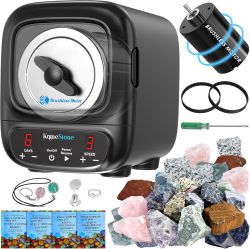
If you're looking for compact but steady, this is my top pick for limited spaces. The soft rubber barrel and brushless motor make it calm and clean.

K2 Elite Professional Rock Tumbler (3 lb, Brushless, Rubber Barrel) - Best Quiet Indoor Starter

  • 100% soft rubber 3 lb barrel; tight clamp‑seal
  • Ultra‑quiet brushless motor; steady RPM under load
  • Noise‑reduction design; simple controls
  • Typical load: ~2.0 lb rocks + ceramic media; fill to ~2/3

If you make a purchase via our links, Northwest Rockhounding earns a commission at no additional cost to you

Pros:

  • Quiet for indoor use; easy to live with for 7–14 day stages
  • Strong seal resists leaks during long runs
  • Gentler on softer stones at a lower speed

Cons:

  • Small capacity limits big beach hauls
  • Single barrel slows multi‑stage workflow


Ultra Quiet Brushless Dual‑Barrel Rock Tumbler (≈7 lb total, Noise‑Cancelling Cover) - Best Workhorse for Regular Use
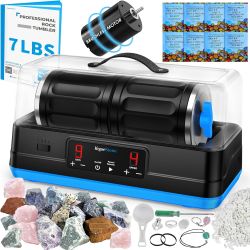
This one shines when you tumble often. Two barrels let you keep stones moving without waiting for a single drum to finish.

Ultra Quiet Brushless Dual‑Barrel Rock Tumbler (≈7 lb total, Noise‑Cancelling Cover)

  • Dual rubber barrels (commonly 2 × 3–3.5 lb)
  • Brushless drive; stable torque when fully loaded
  • Noise‑cancelling cover; up to ~6× quieter than bare plastic barrels
  • Run coarse in one, pre‑polish/polish in the other

If you make a purchase via our links, Northwest Rockhounding earns a commission at no additional cost to you

Pros:

  • Two stages at once speeds total throughput
  • Quieter for garages and sheds; smoother vibration
  • Good fit for agate, jasper, quartz, and small limb casts

Cons:

  • Bigger footprint; heavy when filled
  • More parts to clean between grits


National Geographic Hobby Rock Tumbler Kit (7‑Day Timer, Complete Grit) - Best Budget Beginner Kit
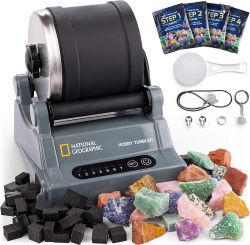
I like this for first projects and gifts. The timer and included grit make it straightforward to learn.

National Geographic Hobby Rock Tumbler Kit (7‑Day Timer, Complete Grit)

  • Leak‑resistant barrel; 7‑day timer with auto shutoff
  • Starter grits, media, and sample stones included
  • Compact size; simple controls for fast setup

If you make a purchase via our links, Northwest Rockhounding earns a commission at no additional cost to you

Pros:

  • Affordable and complete out of the box
  • Easy for classrooms and new rock collectors
  • Light and space‑friendly

Cons:

  • Louder than premium rubber‑barrel models
  • Barrel and motor feel light‑duty for multi‑week cycles


You May Also Like


Leave a Reply

Your email address will not be published. Required fields are marked *